

.png)

Discover how today's pallet buyers are finding suppliers, and what your company can do to become one of the businesses AI recommends.
What's Covered in This Series
Part 1: Why Buyers Choose Some Pallet Companies First
Part 2: Why AI Visibility Is the New Competitive Edge
Part 3: How AI Chooses Pallet Suppliers
Part 4: Preparing Your Website for AI Recommendations
Part 5: 5 Ways to Get More Customers with AI
-----------------------
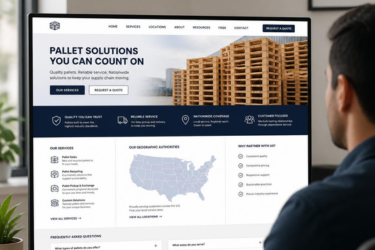
Artificial intelligence (AI) is changing how prospective customers search the internet for your company and its products. When a user enters a query into their browser's search box, AI may reply with a website recommendation that best answers the question. And, if your website responds specifically to the question entered, you may find it among the AI recommendations. Functionally, this means keywords and phrases that attract AI's attention are becoming an extension of standard search engine optimization (SEO). How can pallet manufacturers improve their website setups to be more easily found by AI search tools?
Every website should now adopt a basic setup to be considered AI-friendly.
In the past, the goal was to rank first for a specific keyword on search engine results pages (SERPs). That goal has shifted to focusing on why AI should choose your business when a prospective customer asks for a recommendation.
Technical SEO is the art and science of setting up a website so that Google and AI can accurately index it and connect your brand with specific products, service territories, and services. You cannot run a successful pallet manufacturing website without addressing the technical aspects.
The search terms to emphasize here include "wood pallets," "custom pallets," and "heat-treated pallets." To highlight your services, consider search terms such as "pallet recycling," "pallet manufacturing," and "pallet repair." On your dedicated product pages, as we discussed, focus on technical details such as load capacity, ISPM 15 compliance, heat treatments, and stringer construction.
However, technical SEO is not limited to content. It also focuses attention on the page elements that make up your website. This is where many small businesses make mistakes. Working with website experts who specialize in building and optimizing websites for pallet makers is a practical solution. They focus on site design elements such as title tags, meta descriptions for each page, descriptive URLs, and internal linking.
Prospective customers look for answers. They do not have time to dig through your website for details on 48 x 40 pallets or pallet repair. These buyers know what they want and do not tend to browse. Therefore, your website must include a navigation structure that supports these highly specific searches.
For example, you might set up a website with distinctive pages for products, services, resources, industries, and service areas. Generic content is the enemy of AI's ability to index your site. Your products page should not include a "learn more" option; instead, break down the choices into specific pages, such as "custom wood pallets" and "recycled pallets."

So far, we have looked at what makes a basic pallet manufacturing website high-converting. We also examined the relationship between SEO and AI indexing. Now let's look at how prospective customers will interact with your data. The basic thought process is as follows:
At the same time, resist the temptation to overdo the navigation options. While each phrase or keyword answers a potential question, it can quickly overwhelm a user visiting the site. You can still accommodate AI indexing and SEO requirements by grouping related information into logical categories. If you have a page focused on wood pallets, connect it to pages covering new, recycled, and heavy-duty wood pallets.
From there, connect your product pages to industries that represent your typical customers for these specific items. Heavy-duty wood pallets could be ideal for automotive packaging needs. This page can then link to customization options and quote requests. (Again, you know pallet making. It makes sense to partner with someone who understands website design. That way, you get the assistance needed to create logical navigation that supports AI recommendations and improves conversion rates.)
Your website setup must meet narrowly defined B2B requirements. You address operations teams and warehouse managers. You are not trying to reach typical shoppers. As a result, your website must focus on your buyers' needs, not on your company. Sure, you want to talk about your facility, team, and equipment. That said, this data must take a backseat to your buyer's needs.
Complete product information, including detailed specifications, is the most important element you can provide. Because pallets involve many technical details, make it easy for customers to compare the information you provide. Consider adding design elements that satisfy customers doing initial procurement research (capabilities, logistics, and compliance) while also offering industry-specific search options (automotive, custom pallets, or heavy-duty pallets).
Another element of excellent B2B UX involves a design that accommodates repeat buyers. Returning customers do not need to go through the same details as a first-time visitor. As you rework your website with AI recommendations in mind, add features that enable existing customers to place orders quickly. Some manufacturers include a "returning customer" page. Others offer this function on their quote pages.
Remember that quote requests may not always come from a desktop computer. Plenty of operations managers and similar buyers use tablets during their typical workdays. They are more mobile even than laptops and make it easier to load industry-specific software. Is your website optimized for these mobile users?
In some cases, creating this mobile UX is as simple as making phone numbers clickable and setting up pages for mobile viewing. That said, you may also want to reconsider overall website navigation and form design.
By the way, your pallet business website also needs page speed optimization. Website builders know PageSpeed optimization is measurable and involves compressing and properly sizing large photographs. For nonessential graphics, they may use lazy-loading technology that delays loading elements until the user needs them, thereby speeding up page performance. (If your eyes are glazing over, remember to partner with experts in this field!)
The search paths we have discussed show that the three elements of a converting pallet manufacturing website increasingly overlap. Both people and AI look for a logical setup that answers questions. In simplest terms, this means anticipating a prospective customer's logical questions, answering them on relevant landing pages, and connecting those pages to product information that provides more detail on pallet specifications. From there, it builds trust and guides the customer to a quote request page.

AI has determined that you answer a user's questions about wooden pallets and recommends your website. The site's design is designed to answer increasingly detailed questions and to let prospective customers educate themselves about your products and company. Clear placement of the call to action for quote requests guides the buyer to the right form.
Is it set up for success? Your quote request form must focus on product specifications, available quantities, delivery requirements, and timelines. It should also offer options that logically follow the buying process. For example, start with a field for contact details, move on to pallet requirements, have a field for logistics, and allow for customer specifications. However, long forms intimidate buyers. You can address this issue and still capture the details you need by introducing a short initial form that then opens into several steps. Dropdowns are also good options.
Design for AI is the primary consideration. It shifts the focus from your business and its products to the customer's questions and requirements. What does this look like?
If this all sounds like a tall order, do not worry. How can pallet manufacturers improve their website design? Easy! They educate themselves, then they partner with Pallet Company Marketing to design a website, handle SEO, optimize for local searches, and make the overall setup AI-friendly. Schedule a call today to discuss AI, SEO, and web software integrations!
-----------------------
Winning More Customers in the AI Era
A Five-Part Executive Series for Pallet Manufacturers
✅ Part 1: Why Buyers Choose Some Pallet Companies First
✅ Part 2: Why AI Visibility Is the New Competitive Edge
✅ Part 3: How AI Chooses Pallet Suppliers
✅ Part 4: Preparing Your Website for AI Recommendations
🔜 Part 5: 5 Ways to Get More Customers with AI