

.png)
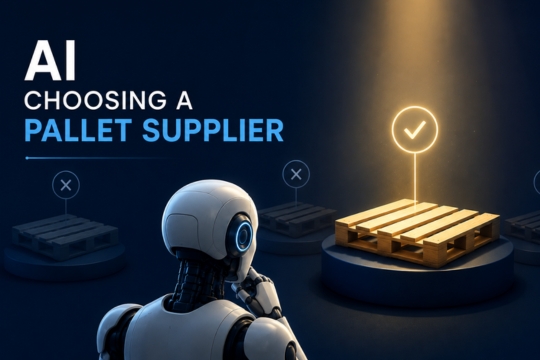
Discover how today's pallet buyers are finding suppliers, and what your company can do to become one of the businesses AI recommends.
What's Covered in This Series
Part 1: Why Buyers Choose Some Pallet Companies First
Part 2: Why AI Visibility Is the New Competitive Edge
Part 3: How AI Chooses Pallet Suppliers
Part 4: Preparing Your Website for AI Recommendations
Part 5: 5 Ways to Get More Customers with AI
-----------------------
In the past, business-to-business (B2B) pallet procurement channels involved word-of-mouth recommendations and print advertising. But how customers find you today has changed. Digital marketplaces for pallet buyers are quickly taking over, and if you are not visible there, you will miss out on new customers. Print media advertising is no longer sufficient. What will it take to become visible today? How do pallet buyers find suppliers online? What can small- to mid-sized pallet manufacturers do to remain competitive in a changing marketplace? Let's talk about it.
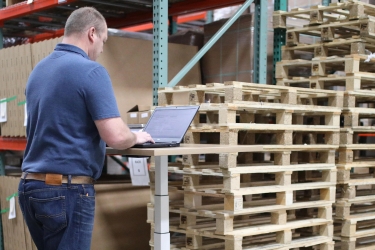
If you have kept up with search engine optimization (SEO) for your company's website, you know that much of the content has targeted prospective buyers typing in "pallets near me." Artificial intelligence (AI) has changed how these searches work. It lets buyers use much more specific search terms. Examples include "heat-treated pallets near me" and "pallet manufacturer near Dallas." As a result, pallet makers must now adjust their content to be much more specific so AI can find their websites. Concurrently, it is essential to include geographic details. And do not forget to supply details on how you can meet the customer's needs today and in the future. Let's break it down.
Supply chains are now top of mind when selecting a company to do business with. Teams do not want to repeat their searches because a supplier cannot provide the number or types of pallets they need. As a result, search terms now also target the qualities they want in a pallet maker. For example, a team might be looking for a "custom pallet manufacturer" who can be a "new and recycled pallet supplier" and act as a "bulk supplier near Dallas." Your website must reflect that you can accommodate all these requirements.
Your website must clearly define your service territory. Err on the side of caution and name each city, county, and region where you ship your products. Also, add pages that outline which operations your pallets are suitable for. Examples include pages titled "Pallets for Distribution Centers" and "Custom Export Pallets."
Each pallet buyer has a problem that needs to be resolved. (In business school, they call it a pain point.) They are looking for something specific that might be unique to them. Maybe they want to find local recycled pallet suppliers online, need someone who handles pallet recycling, or have specific product specifications in mind that are not common. Therefore, position your business as a problem solver and the solution for what the buyer needs.
So, your website should include pages that address these concerns.
As you can see, your website must now be visible across multiple platforms, including social media. Moreover, it needs to address the specific pain points that drive the keywords your prospective buyers type into the search bar.
So far, we have covered how AI has changed the way prospective customers enter search terms. We have also offered suggestions on how to tweak your website's content to better respond to these searches. However, some supplier websites may need more than a few simple tweaks. At the same time, you do not want your website to become a patchwork of pages that lack consistency and continuity, or, worse, lead to broken links.
The ideal pallet manufacturer website must be:
Sometimes, it is easier to start from the ground up than to overhaul what is already there. Only you can judge how your website stacks up against the changing search parameters procurement teams use today. For example, your business must position itself through content that focuses on actual search terms like "new pallet supplier in Dallas" or "heavy-duty pallets for automotive parts." Highly detailed website product pages (for each pallet type) are ideally suited for covering these search terms. If you have been in business for a while, you may have some solid website content to work with.
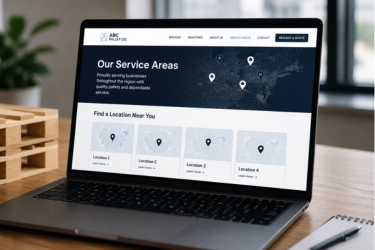
Previously, you might have had one or two sentences on the "About Us" page that identified your service territory. It is no longer enough. You now need geography pages that name each location and address the markets you actually serve there. For example, one page may be titled "Pallet Supplier in Dallas" and include information about the types of pallet products that are available. These address typical customers who are looking to buy your products, want to know about delivery options, and need details about custom capabilities. And no, the other location-specific pages cannot be carbon copies of the one you just put up. Each must be unique to avoid Google classifying it as thin content.
A prospective buyer is looking at your website. While vetting bulk pallet suppliers, these buyers do not want to read that you make "high-quality" pallets. This is a given. Instead, provide the minute details a qualified buyer cares about. For example, what load capacities do your pallets support, which custom sizes are available, what deck configuration do you use, and which entry setups are standard options? Because load capacity includes secondary considerations like load characteristics and construction, include that information as well. If you offer custom builds, say so. Assume that the buyer at this level is somewhat of an expert and willing to read through specs and material details.
When sourcing wooden pallets online, prospective buyers want to know that you can accommodate their order volume and delivery needs. They also aim to know if they can count on you for an ongoing professional relationship. In other words, can you provide the pallets the customer needs during the back-to-school retail season, and do so just as easily and quickly during the holiday season? How long in advance do buyers have to enter an order to request high-volume deliveries during the busiest times in the retail industry?

Have you noticed that more and more businesses are now adding content that includes frequently asked questions (FAQs) either as stand-alone pages or as blog posts? They answer the most common buyer questions that internet users enter into search windows. Examples include "Do you sell recycled pallets?", "What is your minimum order?", and "Do you do emergency pallet deliveries?"
A prospective customer has found you. Your website pages have answered the buyer's questions. They are now ready to make the purchase. Is your website set up for the sale?
How do pallet buyers find suppliers online if they are not using Google searches or social media referrals? Email marketing may be the way. Your customer data is ideally suited for entering into customer relationship management (CRM) software. It lets you create emails to send at regular intervals to prospective and past buyers. You can completely customize the content, which may make your email marketing a viable source of future business.
But you do not have to go it alone. Overhauling, updating, or rebuilding your website is a big task. While you know pallets, Pallet Company Marketing offers professional B2B content creation services. Put the two together and build your customer base. Schedule a call today!
-----------------------
Winning More Customers in the AI Era
A Five-Part Executive Series for Pallet Manufacturers
✅ Part 1: Why Buyers Choose Some Pallet Companies First
✅ Part 2: Why AI Visibility Is the New Competitive Edge
✅ Part 3: How AI Chooses Pallet Suppliers
🔜 Part 4: Preparing Your Website for AI Recommendations
🔜 Part 5: 5 Ways to Get More Customers with AI