

.png)
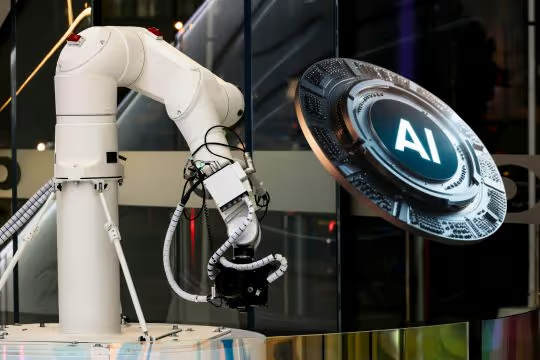
We have previously discussed pallet production robotics and its implications for small to mid-sized manufacturers. At the time, you learned about technologies such as end-of-arm tooling (EOAT) and collaborative robots (cobots). However, we left an elephant in the room without mentioning it: artificial intelligence (AI). Let's talk about what artificial intelligence means for pallet manufacturers. Most importantly, we will look past the hype and the inevitable sales pitches.

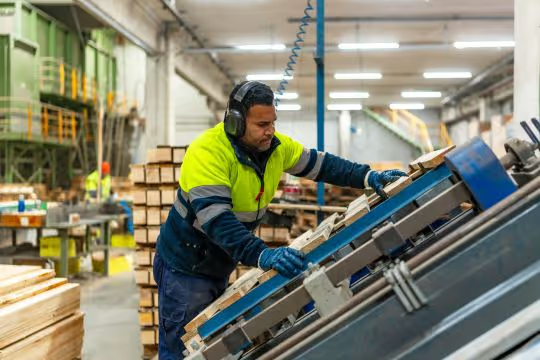
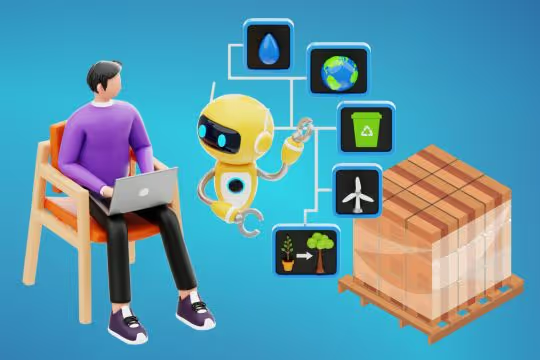
While some technologies may replace employees, artificial intelligence does not. In this context, AI relies on workers to incorporate its suggestions, findings, and alerts to reduce waste, increase output, and minimize unpredictable downtimes. While integrating new technology may have altered your employees' job descriptions, the goal here must be to have AI and workers collaborate effectively. What does this look like?
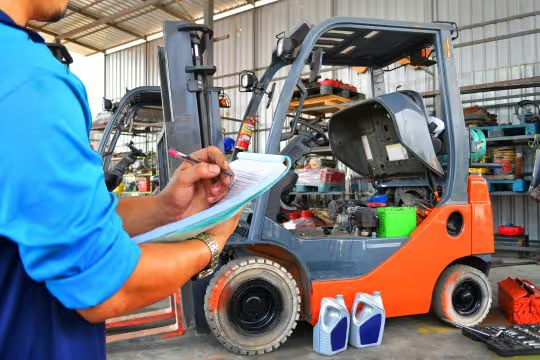
For pallet manufacturers, artificial intelligence means a proactive approach to equipment maintenance. In the past, you might run machines until they fail. Long-time employees attuned to machine noises may have noticed changes, but only after the problems had already become significant. Now, AI monitors minute changes in machine vibrations, operating temperatures, and other conditions that could signal a future breakdown. Your employees receive these readings, interpret them correctly, and predict when saws, compressors, nailers, or conveyors at your facility need service before they break down. It allows you to schedule technology maintenance during typically low-production periods.
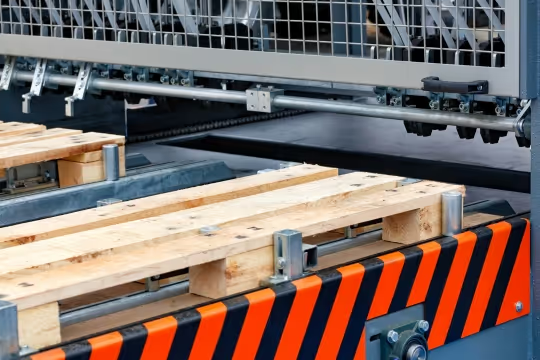
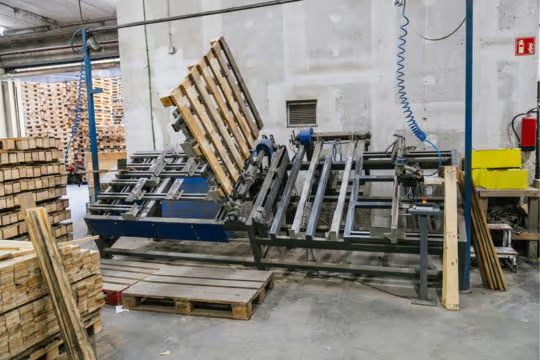
What will it take to squeeze out more productivity from your saws, nailers, and assembly lines? Something as simple as smart nailing line optimization with AI can increase the number of pallets your factory produces per hour while markedly reducing defects. Increasing efficiency no longer means starting the workday earlier or paying for overtime. Instead, it now relies on AI to:
Here, AI helps employees move away from fixed parameters that can bring your production line to a halt when anything changes. It frees up your employees to work with the technology you are bringing into the factory, increasing your return on investment.

Waste is one of the most significant problems that pallet manufacturers face. It dramatically affects your bottom line. In many cases, waste is a direct result of human error. AI has your back. Lumber board inspection sensors scan the boards for defects and automatically grade them. Moreover, it determines the optimal cut patterns based on the analysis of each board. While it is impossible to remove all defective pieces of lumber before they enter your factory, it is now possible to work with the boards you have and still reduce scrap.
Human QC is inconsistent. What one employee considers faulty, another might consider acceptable. AI checks quality against pre-defined patterns and provides objective, continuous verification. It can do so without slowing down or stopping production. Machine learning and computer vision combine to identify commonalities. And, if you find that AI is getting a little too meticulous, you can allow for variances that the machine will learn and incorporate in its workings.
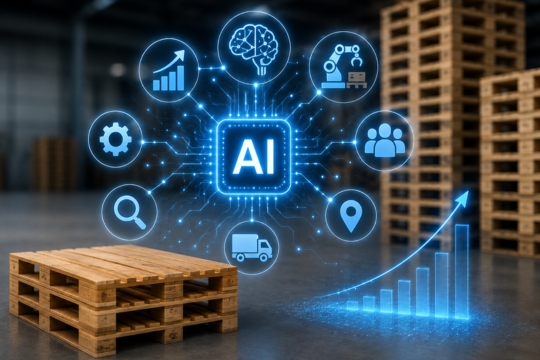
It is essential to note that machine learning, computer vision, and smart factory output are just a few of the capabilities AI offers. While reducing pallet manufacturing waste with AI is one of the most popular uses of this technology, it is also highly effective in the office setting. Once again, you choose which processes you want to automate.
Using AI for forecasting helps predict how much lumber to buy and store, as well as how many pallets to pre-build. The technology analyzes and incorporates data from historical orders, established customer behavior, and predictable production constraints. Depending on the data to which AI has access, it can forecast volume needed by pallet type, pallet repairs, and customer-specific buying patterns.
On the other hand, AI can translate forecasted demand into the necessary inventory. Examples include board cuts, grade, block requirements, and nail quantities. Your business can purchase supplies that will be used rather than storing them and risking them becoming unusable. Also, you will never run out of fasteners because one of the office clerks neglected to place an order when the inventory got low.
Here is what artificial intelligence means for pallet manufacturers who invest in at least some new technology.
For the office staff, this means actionable outputs, such as stock inventory, that provide a cushion without clogging your warehouse. Additionally, you will receive purchase recommendations and suggested build schedules.

We promised you plain English, and here it is. The traditional way of doing business relied on static spreadsheets, overstock that exceeded a needed cushion, and reactive buying that routinely creates budget problems. The AI approach to business incorporates self-learning technology that enables predictive purchasing and optimized (lean) inventory management.
What makes it overwhelming to consider AI is the sheer magnitude of the technology. There is also the misunderstanding that you have to jump in with both feet. It is not true! AI enables the gradual and scalable integration into your manufacturing and office processes. Start small; vision-based inspection analytics are a great way to get started. Once you feel comfortable and see the benefits, consider integrating AI with other existing automation. Eventually, you will look forward to expanding AI for forecasting and ongoing operational optimization.
Whenever you introduce new technology or upgrade existing technology in your factory, it is a good idea to inform both current and prospective customers. Doing so demonstrates that you are at the forefront of pallet manufacturing, which signals that your business is trustworthy and suitable for customers who are also integrating new technology into their operations.
Our team brings an expert pallet industry marketing strategy to the table. While you focus on integrating new technology or AI into your factory, we handle your digital marketing to expand your online presence and increase sales. Most importantly, targeted search engine optimization (SEO) strategies ensure you are identified as the local pallet manufacturer that caters to customers who rely on their own versions of scalable AI technology.
Let's talk about it. Schedule a call today!