

.png)
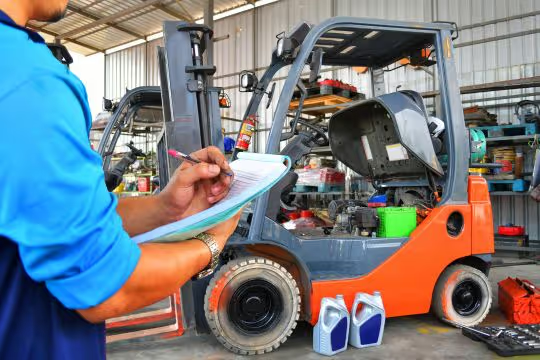
Pallet companies have a bundle of equipment, machinery, and facilities to manage, all of which require maintenance and repairs. The question every pallet plan must ask, then, is whether it’s more economical to take a proactive or reactive approach to those necessities.
When assessing preventative vs. reactive maintenance in pallet manufacturing, several factors should be considered. Many pallet manufacturers find that a combination of preventative and reactive maintenance approaches is optimal, allowing them to reap the full benefits of each while minimizing the downsides of either.

Preventive maintenance is a method of maintaining machines and equipment designed to proactively prevent them from breaking down. Rather than waiting for failures to occur, pallet businesses with preventive maintenance procedures in place perform maintenance duties on a regularly scheduled basis based on the equipment’s condition, usage, or a specific time interval.
A preventative maintenance plan may include:
Kinds of preventative maintenance strategies include:
Just like when you implement proven marketing strategies for pallet business, when you properly implement a strong preventative maintenance program, you optimize your use of limited resources. In the case of asset maintenance, you reduce unplanned downtime, support safety compliance, and achieve long-term cost savings. It helps prevent significant breakdowns, improve reliability, and prevent critical failures from disrupting business operations.
Fix-it maintenance, also known as reactive maintenance, run-to-failure, or breakdown maintenance, is implemented only after an actual equipment failure. Instead of scheduling maintenance tasks before issues arise, fix-it maintenance crews conduct emergency repairs in response to unexpected failures.
Fix-it maintenance activities generally include:
The basic concept of fix-it maintenance is that by performing maintenance only when it’s actually needed, you avoid expending resources and time on unnecessary tasks. By eliminating preventive maintenance activities in favor of fix-it maintenance, you may save money in the short term.
However, depending too much on fix-it maintenance can lead to expensive repairs, production-time losses, and sudden failure. If there’s no backup in place for a critical asset when it fails, the ensuing downtime could cost you more in time and resources than you saved by opting against a preventative maintenance strategy. These are critical factors to consider when weighing the benefits and drawbacks of preventative vs reactive maintenance in pallet manufacturing.

You may need more careful planning to effectively implement a preventative maintenance strategy, but it can save you money over the long run, improve equipment performance, and reduce the incidents of expensive failures.
As this section will demonstrate, where critical assets are involved, a fix-it maintenance approach is not the most economical, but by the same token, where non-critical assets are involved, preventative maintenance approaches can be overkill.
Many pallet plants have adopted a preventative maintenance approach because of the numerous advantages it offers. Preventative maintenance strategies help reduce risk, support long-term savings, and balance resource allocation.
There’s no denying that a preventative maintenance strategy requires a dedicated budget and upfront planning, but over time, it reduces maintenance costs. Catching problems or potential problems early on enables you to avoid expensive equipment failures, emergency repairs, corrective maintenance activities, and unplanned downtime.
A preventative maintenance program ensures that equipment receives adequate maintenance before problems develop. It helps to improve equipment reliability, avoid failures, and extend equipment lifespan.
By planning maintenance tasks in advance, you reduce the risk of unexpected downtime. To prevent reduced productivity from unplanned breakdowns, you schedule maintenance interventions during periods when operations will be least disrupted.
A preventative maintenance program enables maintenance crews to properly plan the most efficient maintenance tasks and personnel allocation. It helps to ensure that you have spare parts available when you need them. In these ways, maintenance management is more predictable and cost-effective.
By conducting equipment maintenance before failures occur, you can extend the life of your assets and optimize your return on investment. By preventing significant equipment breakdowns, you also lower the risk of permanently damaging critical components of your operation.
Regularly scheduled inspections conducted as part of a preventative maintenance plan reduce liability risks, improve safety, and ensure compliance with relevant regulations. By preventing critical breakdowns, you also protect customers, staff, and your business's reputation.
Preventative maintenance programs can make it easier to implement predictive maintenance activities such as advanced analytics and condition monitoring. Predictive maintenance strategies take proactive maintenance tasks to the next level by anticipating problems before they occur.
Although fix-it maintenance does have its risks, it can also be a useful part of a pallet company’s larger maintenance management program. In some cases, it can offer even greater cost savings than preventative options, especially for lower-value equipment.

While a preventative maintenance approach requires that you invest in a whole preventative maintenance program for it to be effective, fix-it maintenance involves little planning. Since you don’t require scheduled maintenance duties, you can significantly reduce your maintenance budget.
A reactive maintenance approach prevents unnecessary maintenance tasks by intervening only when a problem happens. This can be particularly beneficial in the case of equipment that is relatively inexpensive, simple to replace or doesn’t terribly impede operations when it breaks down.
Fix-it maintenance approaches are much simpler to put into effect due to their nonreliance on routine inspections, a full preventative maintenance plan, or predictive activities. Maintenance crews need to perform maintenance only when assets fail.
In the cases of equipment that isn’t critical and doesn’t cost much to repair, fix-it maintenance can be a more cost-efficient option than preventive maintenance. Waiting until assets break down before conducting maintenance can be more economical than scheduling routine maintenance tasks.
Because you’re not tying up maintenance personnel to perform regularly scheduled preventative tasks, you can focus your resources in other areas until and unless an emergency event takes place that requires their immediate attention.
By combining the best elements of preventive vs. reactive maintenance in your pallet manufacturing approach, you can allocate your limited resources in ways that most powerfully help your business. For example, when you're not expending so much on maintenance, you can put more into your marketing. Call us today to learn about marketing options for manufacturing business.