

.png)
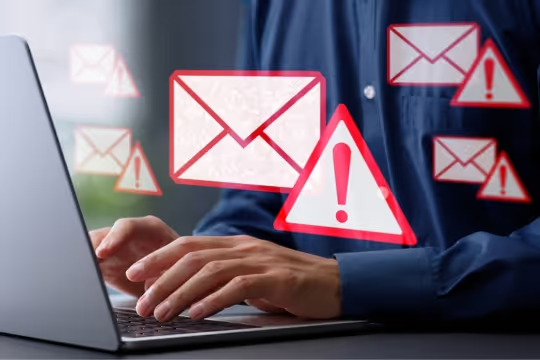
The dawn of the AI age is creating new possibilities across a broad range of economic sectors. Unfortunately, it's also proving a boon to cybercriminals. They're using AI tools to supercharge fraudulent email scams, expanding their reach and making detection more challenging. For pallet companies that rely heavily on email in day-to-day operations, this is an existential threat. Therefore, the principals of such companies need to recognize the fingerprints of AI-driven email scams. That way, they can take action to protect business revenue, inventory, and internal systems. Here, we'll discuss how AI email scams target pallet manufacturing companies and how to guard against them.
Email has always been a preferred attack vector for scammers. After all, sending an email, or even thousands of them, costs virtually nothing. Historically, however, preparing email content did require human intervention. That's why email scams have always had obvious tell-tale signs, like misspellings, a general lack of formality, and the absence of realistic-looking graphical elements.
The emergence of AI tools is changing all of those things. AI can compose scam emails at scale, fully customized for each target. And it can craft responses designed to defeat a company's screening processes. In the pallet industry, for example, AI can craft emails that use industry-specific language that increases authenticity. And the tools can directly scrape a target company's website, social media channels, and customer lists to sharpen its messaging. Human-driven email scams could never be so precise at scale. However, AI not only gives scammers these capabilities but can also generate hundreds or thousands of personalized emails in a matter of minutes. That's the key to how AI email scams target pallet manufacturing companies and evade detection.
Although email scams can change from moment to moment, there are a few common themes in those targeting pallet companies now. The following are some of the most common scams to watch out for:
One current scam relies on impersonating a legitimate pallet buyer. The emails will typically contain industry-standard vocabulary, such as block pallets, heat-treated, and mixed loads. The purpose is to convince the reader that the email originated from a legitimate buyer. They may also mention real-world shipping lanes gleaned from public freight information. The emails will also come from spoofed email domains that are near-perfect matches for known customers.
Another common current scam involves emails purporting to be from known suppliers or carriers. For example, they may appear to come from a lumber vendor or a freight carrier known to the business. Furthermore, the AI backend will send dynamic replies based on responses from the targeted company. They may even send false routing instructions via a link that delivers malware into company systems.

AI is also widely used to power highly convincing credential-harvesting campaigns. They may include links to realistic customer portals or false invoice downloads. Some even create landing pages that look identical to company webmail login screens. In all cases, the goal is to trick the user into typing their company username and password into the fake site. The attacker can then use those credentials to gain access to protected systems.
Fortunately, AI-powered email scams should still show several red flags if you know what to look for. They include:
To guard against AI-powered email scams, it's wise to implement a contact-validation procedure. That can help you tell when you're dealing with a legitimate contact or a scammer. Here's what to do.
There are a few quick checks that will weed out most scams. The first thing to do is check the sender's domain to see if it leads to a public website. If not, the domain is probably false. Next, look up the company's name in the state business registry where they claim to operate. If they're not listed, the email is likely fake. You can also check DOT or freight databases for information on a new contact.
There are countless benefits of AI in pallet manufacturing. One of them is that you can use it to screen incoming email requests. Consider deploying an AI-based email scanner that can automatically quarantine suspicious emails. They can look for tell-tale signs of AI-generated emails, like inconsistencies in text, spoofed sender domains, and suspicious links. That can keep many of the most dangerous scam emails from ever reaching an employee in the first place.
There are also some IT upgrades to consider that can help fend off AI-generated attacks. Here's what to do.
At a minimum, it's wise to configure email systems to reject attachments by default. If necessary, implement a whitelist for pre-vetted senders. Additionally, it's a good idea to enable domain authentication using DMARC, SPF, and DKIM. Those let other email servers know for sure when an email from your company came from your company's official email server. You can also set your email system to quarantine or reject emails from servers that don't meet domain authentication standards. And if a client or partner can't get emails through to you because of that, encourage them to align their email system with modern security standards.
To prevent stolen credentials from becoming a problem, there are a few simple steps. One is to create a procedure to cull unused credentials monthly. Look for accounts belonging to employees no longer with the company. That helps eliminate zombie accounts that scammers may gain access to. Reviewing access rights to restrict account access to sensitive systems is also a good idea. It's also wise to set login time restrictions to prevent access during off-hours when IT staff aren't on duty. And mandating multi-factor authentication and forcing periodic password changes is helpful.
Informed employees are the best defense against email scams. So, hold regular training sessions that explain the types of scams to watch out for. Ideally, reinforce the lessons with scam emails the company actually received. That can help employees spot red flags before interacting with a suspicious email.
The first step when a suspected AI-generated scam email arrives is to quarantine it. Do not interact with the message or its sender. If it's too late for that, stop interacting as soon as concerns arise. Next, alert in-house or outsourced IT staff to begin investigating. If necessary, reset the passwords of any potentially affected accounts. And if the email included the name or information of a known vendor or customer, alert them to the situation. There's a good chance that the scam isn't targeted at just one company.
Additionally, some post-incident steps to take include:

Unfortunately, the number of sophisticated email scams enabled by AI will only increase over time. And as the AI tools themselves improve, the threat will only intensify. However, cybersecurity researchers are already hard at work developing countermeasures to AI-powered threats. It's an arms race whose ultimate outcome won't be clear for decades.
In the meantime, however, taking concrete steps to guard against AI-powered email scams is vital. Now that you know how AI email scams target pallet manufacturing companies, you should have a good idea where to begin. A combination of proactive contact verification and employee training is the minimum that every pallet manufacturer should perform. And making strategic IT investments to modernize digital processes and enhance cybersecurity is advisable. To help, please explore our pallet industry software solutions, which leverage the latest technology to streamline operations.