

.png)

Artificial intelligence (AI) is equally hailed as a job destroyer and a job creator. For small- to mid-sized manufacturing companies, integrating AI is a way to grow the business (and subsequently employ more workers) without spending a mint. Additionally, it may be the best option for staying competitive in an increasingly automated manufacturing landscape. Let's take a closer look at how pallet companies are using AI tools to improve operations.
Which pain points can AI resolve at the typical pallet manufacturing company? Three possibilities stand out.
What makes AI so important in the changing market is its ability to connect across platforms, enabling ongoing growth.

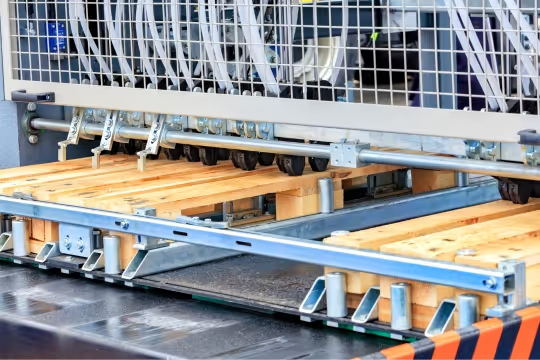
What are attractive AI tools for companies of your size? Additionally, how do you go about overcoming challenges in pallet automation? We have already mentioned AI to predict (and avoid) equipment failures. Integrate the technology to analyze machine performance data of saws, nailing lines, conveyors, and other technologies you rely on to handle materials at any point of the manufacturing process. However, there is so much more that AI can bring to your facility.
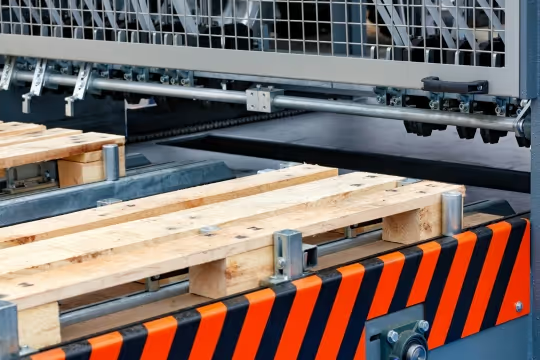
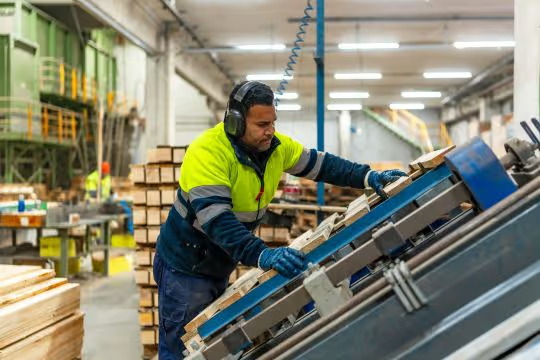
Catch problems before your customer does. Virtually eliminate refunds and discount requests. More accurate than the human eye, automated pallet inspection scans the products at each stage of the manufacturing process. Here, AI can identify broken deck boards, missing or broken nails, cracked stringers, and other quality defects in real time. For your customer, this means consistent quality. For your employees, it means focusing on tasks other than quality control.
Your order volume changes seasonally and based on historical order numbers. Doing it by hand, production planning and scheduling can be thankless tasks. Besides the propensity for error, there are other figures to integrate, such as your staff members' labor availability and resource purchases. Artificial intelligence combines the data from various sources, analyzes it, and makes recommendations. AI helps companies deliver orders on time, reduce the sudden need for costly overtime, and prevent work stoppages due to insufficient materials.

Besides generating predictive maintenance reports and analyzing asset-tracking data, AI can also significantly change how your customers interact with the business. For example, repetitive customer questions can be easily answered with AI tools synced with various elements of the production line. Customers appreciate getting up-to-date information on outstanding orders and pricing for future ones. By leveraging machine learning, AI can also respond to more general customer questions, draft basic order proposals, and generate typical pallet quotes.
From there, you can expand the functionality of AI in interactions with customers. An example is the design of customer self-service portals that allow invoice downloads, automated payments, and inventory checks. Additionally, AI-powered email management can respond immediately to billing questions and order changes. It can then sync the data with other AI components to enable seamless changes that customers are demanding.
Sawmill pattern recognition scans raw materials and maps the cutting pattern that produces the least waste. Reducing scrap saves you money in material costs. Better profitability per board can free up funds needed for machine upgrades or additional AI tools.
Because you are in the driver's seat when it comes to bringing in AI, you have the option of mixing and matching free and fee-based options. If this is your first time using AI, it is a good idea to select one aspect of your manufacturing business that could benefit from integrating the technology.
When you are ready to go beyond machine operating-temperature monitoring and inventory control, you can use AI for several customer service functions. Doing so is particularly helpful for following up on leads, communicating with customers in different stages of the sales funnel, and devising marketing campaigns based on past customer needs. Possible platforms here include HubSpot AI and Zoho CRM.
For the pallet manufacturer ready to go beyond basic introductions to artificial intelligence, there are next-level AI automation ideas. Examples include autonomous guided vehicles (AGVs), which guide forklift traffic and handle repetitive tasks such as carrying raw materials from storage to the manufacturing floor. Typical tools used include laser navigation, floor markers, and even QR codes.
Radio-frequency identification (RFID) smart pallets enable you to track pallet movement and shipments throughout the supply chain. All you need is a dedicated tag that allows for automatic scanning, reading, and data storage. Readers can be installed on warehouse doors, loading docks, and in distribution centers. The tags themselves can be embedded in the pallets or simply attached.
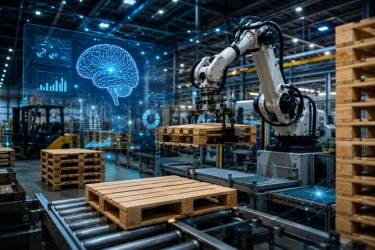
There was a time when you needed little more than skilled labor, quality lumber, and functioning machinery to meet your economic goals in pallet manufacturing. But like so many other industries, pallet fabrication, too, has to become forward-looking and embrace technology. AI now determines how your business operates, grows, and competes with other companies.
Additionally, AI responds to increasingly sophisticated customers who seek immediate answers and are unwilling to leave messages or wait for callbacks. Moreover, consider that AI offers some insurance against possible labor shortages. Tasks like order processing, scheduling, reporting, data entry, and inventory tracking can now be handled by artificial intelligence, freeing your team to focus on what you do best: making high-quality pallets.
So far, we have discussed how pallet companies are using AI tools to improve operations. In the process, we have noted that the technology:
With all these advantages, what is holding you back? You probably already use CRM platforms, put together reports, and draft marketing content. Now, AI can do it for you. Can you really afford to compete with companies that are already embracing this technology?
Of course, if your AI is going well, but your marketing is not up to par, you are still at a disadvantage. This is where we can help out. Discuss industry-specific operational solutions for your unique company by scheduling a call today!