

.png)

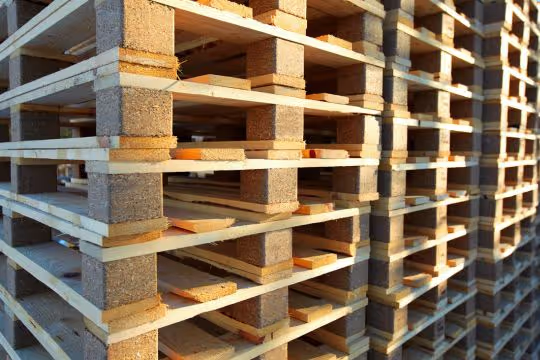
The best pallets for automated warehouses are those that meet the equipment's dimensional, structural, and handling requirements. Pallets that work well with conventional forklifts can still cause problems in automated systems if their dimensions, construction, or condition are inconsistent. These differences can interfere with conveyor movement, robotic handling, and automated storage operations.
A pallet can meet its rated load capacity yet still have construction or clearance issues that affect equipment compatibility. Understanding what pallets are best for automated warehouses begins with identifying these requirements before purchasing large quantities. Warehouse operators should confirm pallet compatibility during automation planning, before equipment is installed.
Pallet selection depends on how each design performs under the facility's operating conditions, including load distribution, equipment clearances, and handling requirements. Reliable automated handling also requires consistent pallet dimensions, sound construction, sufficient load capacity, and controlled deflection under operating loads.
Equipment specifications identify the required pallet dimensions, bottom-deck configuration, clearances, and load limits to ensure proper movement and support throughout the system. A block pallet with four-way forklift entry can still have a bottom-deck configuration that interferes with conveyor operation. Likewise, a pallet that performs adequately on a floor-supported conveyor can experience excessive deflection when stored across rack beams.
Wood, plastic, block, stringer, new, recycled, and custom pallets can all be evaluated for automation. The deciding factor is whether the actual pallet design and condition meet the documented equipment specifications.
.png)
Variations in pallet dimensions or construction can affect load movement, transfers between equipment, and placement in automated storage systems when they exceed the equipment's positioning or clearance tolerances. Two key factors are dimensional consistency and structural performance.
Pallet dimensional consistency depends on maintaining specified measurements for length, width, height, board spacing, deck placement, and overall geometry. Dimensional tolerances establish the acceptable variation from these measurements, while squareness describes how closely the pallet's corners and sides conform to its intended rectangular shape. Both affect how accurately pallets align with automated handling equipment.
Here's how these factors affect automated handling:
Construction defects like protruding nails, broken deck boards, missing components, and loose fasteners can catch on handling equipment, disrupt pallet movement, and cause conveyor stoppages. Wood pallets with the same nominal footprint can also vary in board placement, spacing, and repair quality, affecting consistency between units. Acceptable dimensional variation depends on the equipment's positioning and clearance limits.
A pallet's structural performance depends on its loading and support conditions. Static capacity applies to stationary loads, dynamic capacity to loads during handling, and racking capacity to loads supported at specified points. These ratings should be evaluated under their stated loading and support conditions, consistent with applicable pallet-testing standards such as ISO 8611-2. For racked pallets, deflection, or bending under load, depends on construction, material stiffness, weight distribution, and the distance between supports.
Pallet deflection varies with support conditions and load distribution, particularly when weight is concentrated in certain areas or the pallet spans rack beams without continuous support. Repeated handling can expose weakened joints, damaged boards, or other structural problems. Purchasing teams should confirm that pallets meet the required load capacity and deflection limits under actual support conditions.
Pallets can jam, shift, or fail automated inspections when their dimensions, condition, or contact surfaces are incompatible with the conveyor system. Inadequate contact between the pallet's bottom deck and conveyor rollers or chains can disrupt movement or transfers between equipment sections. Damaged boards and protruding fasteners can obstruct pallet movement, while inconsistent dimensions or unstable loads can cause misalignment, equipment faults, or product damage.
Warning signs to look for:
Conveyor stoppages can also result from improper load placement, sensor issues, equipment settings, or maintenance problems. Recurring faults should be investigated by checking both the pallets and the handling equipment.
A lower purchase price can lead to higher operating costs when pallets require additional inspections, replacements, or labor to clear stoppages. Product damage and interrupted throughput can add to those costs. These potential costs should also be considered when reviewing pallet automation system requirements and the overall costs and benefits of automation investments.
.png)
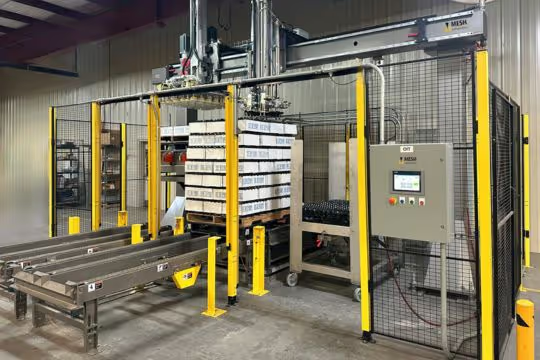
Automated storage and retrieval systems (AS/RS) use equipment such as conveyors, lifts, and shuttles to move loads into and out of designated storage locations. These handling and storage operations require pallets that meet the system's specifications for dimensions, load capacity, equipment interfaces, and allowable deflection.
Pallets supported across their underside experience different loading conditions from those resting on separated support points, such as rack beams. Excessive deflection under storage loads can reduce equipment clearances and compromise load stability.
AS/RS pallet requirements also include loaded-pallet dimensions, weight distribution, bottom-deck construction, and compatibility with transfer equipment. A 48 × 40-inch block pallet can work in an AS/RS designed for its dimensions and construction. Four-way entry allows forklifts and compatible handling equipment to access pallets from multiple directions, but it does not guarantee suitability for every AS/RS configuration.
Some installations require custom pallet designs or slave pallets, which are approved carriers placed beneath pallets or loads to ensure consistent handling. Purchasing teams should verify the AS/RS equipment's approved load carriers, support arrangements, and allowable deflection before selecting pallets, even when using standard sizes.
When comparing wood, plastic, new, or recycled pallets for automation, purchasing teams should evaluate construction consistency, structural performance, handling requirements, and replacement costs alongside material and condition.
Wood pallets are available in standard and custom block or stringer designs for automated warehouses. However, variations in board placement, fastener condition, and manufacturing quality can affect handling consistency, while moisture changes can alter wood dimensions and structural performance. For automated handling, wood pallet designs must also provide adequate structural strength and compatible contact surfaces.
Plastic pallets offer consistent molded dimensions and component placement when manufactured to specification. They are suitable for some captive or closed-loop systems, where pallets remain within a controlled distribution network. Load capacity, deflection, temperature performance, conveyor contact surfaces, and replacement costs vary by pallet design.
Neither material is automatically better. Choosing between wood and plastic pallets depends on the facility's operating conditions, handling equipment, and total lifecycle costs.
Can Recycled Pallets Be Used in Automated Warehouses?
Recycled pallets can work in automated facilities, but previous use and repairs can introduce differences in board placement, fasteners, dimensions, and structural condition. Consistent grading and inspection help identify these variations before pallets enter the system.
Pallet grading describes how suppliers classify pallets by condition or other quality criteria, although grading standards can vary between suppliers. Facilities considering recycled pallets should establish inspection criteria for dimensions, missing or damaged components, repairs, fastener condition, and structural performance.
Systems with tighter tolerances can require new or custom-manufactured pallets if recycled suppliers cannot provide the necessary consistency. However, even new pallets can cause handling problems if their construction interferes with equipment clearances or contact points. Purchasing teams should assess both equipment compatibility and the supplier's ability to consistently meet agreed specifications.
Custom pallets may be needed when standard designs cannot meet a facility's dimensional, structural, or handling requirements. Their specifications should define the required construction and performance characteristics based on equipment requirements and actual load conditions.
Customization can be worth discussing when:
Custom pallet designs can involve changes to deck-board spacing, bottom-deck construction, structural components, or overall configuration based on equipment requirements and load conditions. Before production, buyers should verify the manufacturer's capabilities and, where needed, test the proposed design under representative handling and storage conditions.
.png)
Before placing a large order, purchasing teams should review the equipment manufacturer's or system integrator's specifications with pallet suppliers, including the required pallet characteristics and criteria for accepting or rejecting supplied units.
Acceptance criteria should be measurable and agreed upon before purchasing. Dimensional requirements should specify permitted tolerances, while structural requirements should identify the loads and support conditions used for evaluation. Equipment suppliers, system integrators, and pallet manufacturers should resolve conflicting specifications and test representative samples before full-scale orders are placed.
Reliable automated handling and storage depend on pallet dimensions, equipment compatibility, structural performance, and load characteristics, not just standard sizes or purchase prices. Purchasing teams should confirm specifications, assess supplier consistency, and validate representative pallets before committing to substantial quantities.
For pallet manufacturers and suppliers looking to reach commercial buyers interested in warehouse automation, Pallet Company Marketing provides custom B2B manufacturing marketing solutions focused on reaching qualified industrial customers.